

Adventure travelers and nature enthusiasts seeking to experience and understand Yosemite’s legendary granite formations, from casual viewpoints to climbing culture.
Understanding Yosemite’s Granite Giants: Geology and Formation
The granite you’re staring at in Yosemite is roughly 100 million years old. Back then, molten rock cooled slowly miles underground, forming massive plutons—huge bubbles of granite that crystallized into the hardest stuff the Sierra Nevada has to offer.
What makes Yosemite special isn’t just the granite. It’s what happened next.
About 2-3 million years ago, glaciers started carving through the valley. Not once, but repeatedly during multiple ice ages. These rivers of ice—some over a thousand feet thick—scoured the granite, plucking away weaker rock and polishing the harder sections into those impossibly smooth faces. Half Dome’s sheer northwest face? A glacier basically sliced it off like a knife through cheese.
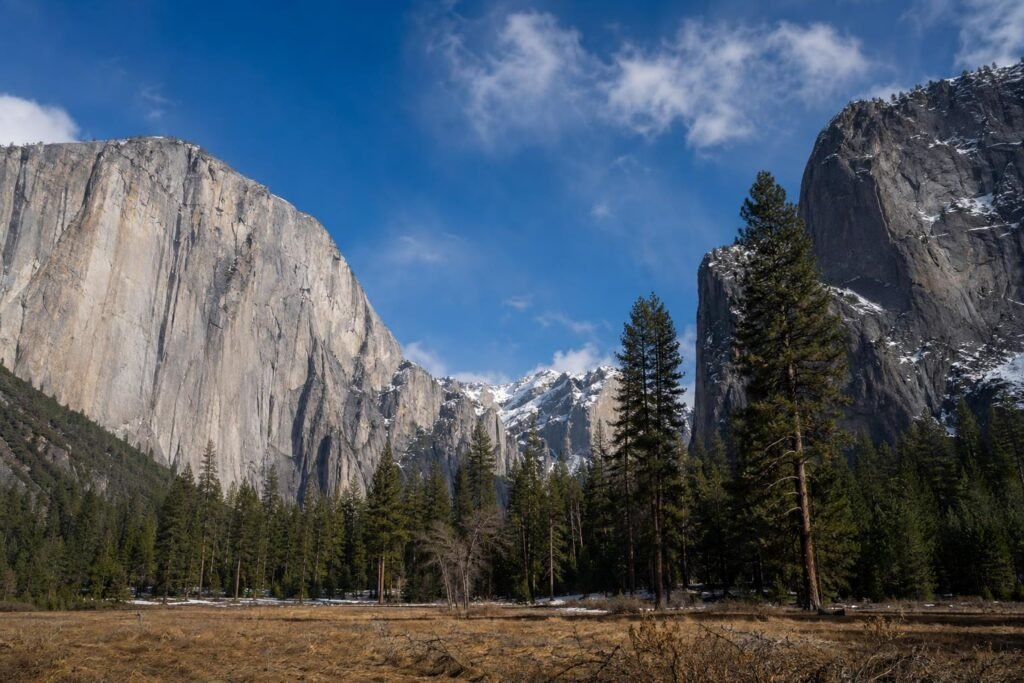
Massive granite walls rising thousands of feet above valley floor, with patches of snow still clinging to shadowed crevices and ponderosa pines in foreground.
The rock here breaks along natural joint systems. Where joints were closely spaced, glaciers excavated entire sections, leaving behind the vertical walls. Where joints were sparse, you get these massive unbroken expanses—like El Capitan’s southwest face, the largest granite monolith on Earth with barely a crack for 2,000 feet.
You can actually see the evidence if you know where to look. Those rounded domes scattered throughout the park—like Sentinel Dome or the backside of Half Dome—that’s where ice flowed over the top, grinding everything smooth. The vertical faces mark where the glacier hit head-on and had to carve its way through.
The granite’s composition matters too. It’s full of quartz, feldspar, and mica crystals that interlock like a three-dimensional jigsaw puzzle. That’s why it can support these insane vertical walls without crumbling. And why climbers trust it with their lives.
El Capitan: The Crown Jewel of Vertical Rock
El Capitan rises 3,000 feet straight up from the valley floor. No gradual slope, no foothills leading up to it. Just 3,000 feet of nearly vertical granite that seems to grow larger the longer you stare at it.
It’s the most famous rock face on the planet, and once you’re standing in the meadow below, you understand why. The sheer scale messes with your depth perception. Those tiny colored specks halfway up? People. That barely-visible line running up the southeast face? The Nose route, probably the most recognized climb in the world.
Warren Harding made the first ascent of The Nose in 1958. Took him 47 days over 18 months, with fixed ropes he’d climb back up each time. These days, speed climbers do it in under two hours. Alex Honnold free-soloed it—no ropes—in 2017 as part of his Freerider route. That story alone brings thousands of climbers here every season.
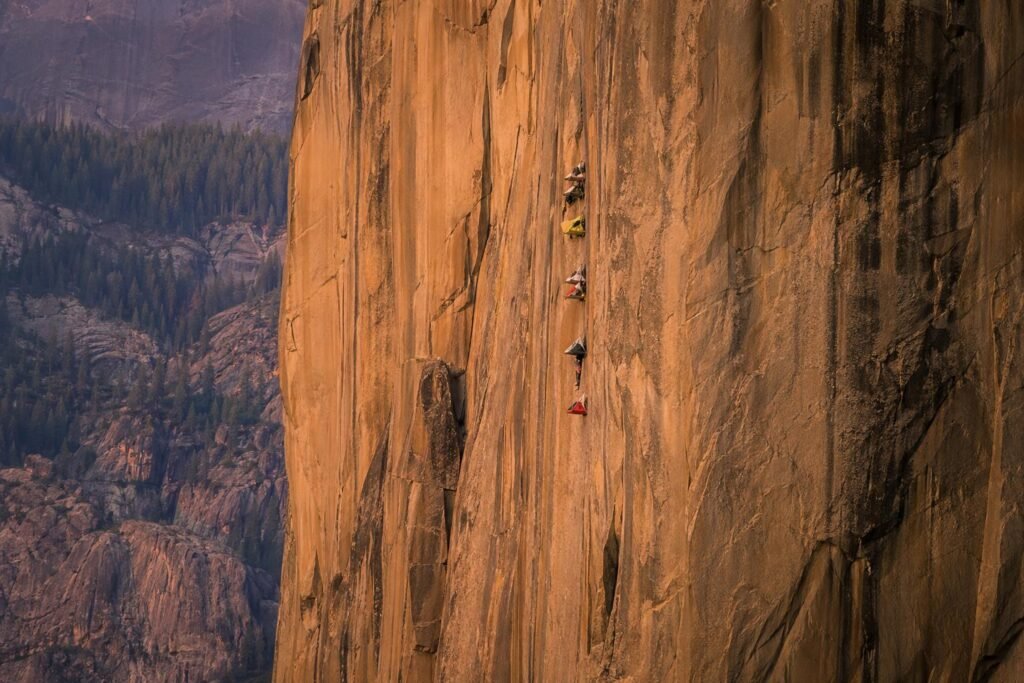
Climbers’ colorful portaledges suspended on the sheer granite face, looking impossibly small against the massive wall, with evening light warming the rock.
You don’t need to climb to experience El Cap though. I usually start at El Capitan Meadow early morning, when the light hits the wall and you can spot climbers with binoculars. Rangers sometimes set up telescopes there during climbing season. Most people here join a ↗ guided climbing tour at El Capitan’s base where you actually get to try basic moves on the lower sections while guides explain the routes hundreds of feet above.
The base itself is worth exploring. Walk right up to it. Touch the granite. You’ll find chalk marks from climbers, sometimes abandoned gear, and if you’re there dawn or dusk, you might catch teams starting their multi-day ascents or topping out after several nights sleeping on portaledges bolted to the wall.
Three main routes get most of the traffic: The Nose (the prow splitting the face), Salathé Wall (the left-ish side, considered the best free climb), and Zodiac (faster, more direct). Between May and October, there are usually 50-100 climbers on El Cap at any given time. You can track them on Mountain Project or just scan the wall yourself.
Half Dome: Yosemite’s Most Recognizable Summit
Half Dome isn’t actually half of anything—it just looks that way from the valley floor. About 20% of the original dome sheared off during the last ice age, leaving that distinctive vertical face that’s become more photographed than most celebrities.
The thing rises 4,737 feet above the valley. That sheared face is nearly a mile high of sheer granite.
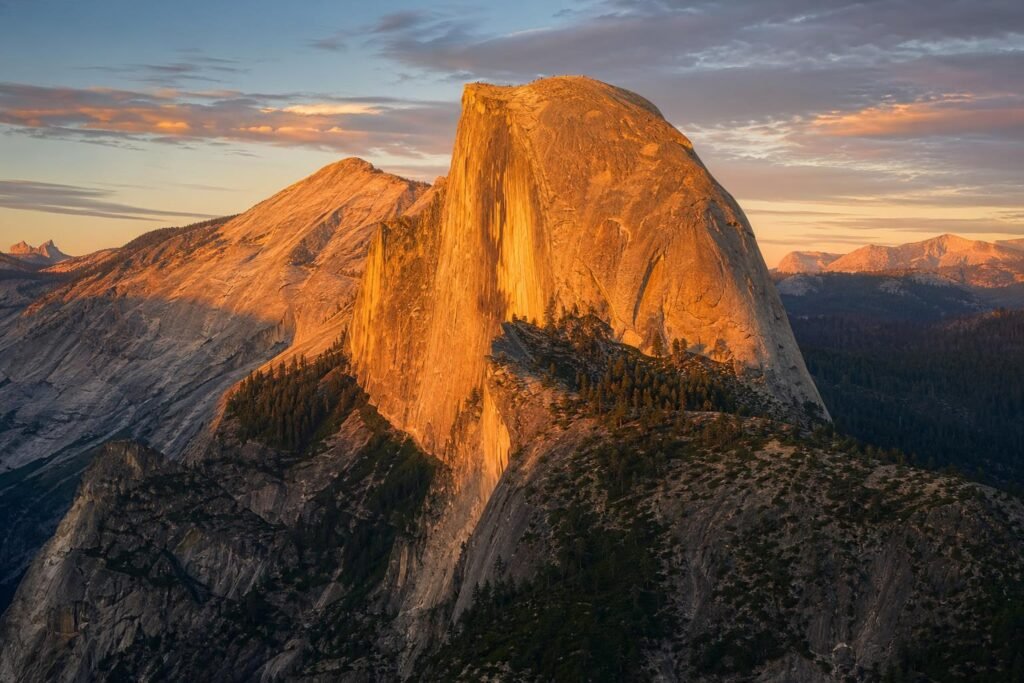
The entire northwest face catching amber light, with the cable route visible as a thin line up the rounded back, scattered hikers like dots on the summit
Most people know Half Dome from the cable route—those metal cables bolted into the granite that let hikers haul themselves up the final 400 feet. You need a permit now, limited to 300 people per day. The lottery opens in March for summer dates. Without cables, that polished granite dome would be unclimbable for anyone not carrying ropes and gear.
I’ve done it twice. The first time I got there at 5 AM and had the cables mostly to myself. The second time I showed up at noon like an idiot and spent 90 minutes in a slow-motion traffic jam of hikers. Go early or don’t go at all.
The hike is 14-16 miles roundtrip depending on where you start. Most people do it from the valley floor via the Mist Trail, which is exactly what it sounds like—you get soaked passing Vernal Fall. The sub-dome section before the cables is where people realize they’ve underestimated this hike. It’s steep, exposed, and you’re already 7 miles in.
From the summit, you can see pretty much the entire park. Clouds Rest to the north, the Clark Range to the south, and if it’s clear, you might spot Mount Conness near Tioga Pass. But honestly, half the people up there are too busy recovering from the climb to care about the views.
Best non-summit viewpoints: Washburn Point gives you the classic profile shot. Olmsted Point on Tioga Road shows the back side—the rounded part that didn’t shear off. And from Mirror Lake when the water’s still, you get the reflection that Ansel Adams made famous.
The rock itself is granodiorite, slightly different from El Cap’s granite. It’s about 87 million years old, formed when molten rock cooled slowly beneath the earth’s surface. The ice age carved everything else away, leaving this massive knob of rock behind.
Best Viewpoints and Photography Spots for Rock Face Viewing
Tunnel View is where everyone stops first and for good reason. You pull off Highway 41 just past the tunnel and suddenly—El Capitan on the left, Half Dome straight ahead, Bridalveil Fall on the right. It’s the money shot, the postcard angle, the view that makes you pull over even if you’ve seen it a hundred times.
Early morning works best here. You want that soft light hitting El Cap’s face before the crowds arrive and before the valley fills with haze. I’ve been there at 6 AM in May with maybe three other people. By 10 AM it’s a zoo of tour buses and selfie sticks.
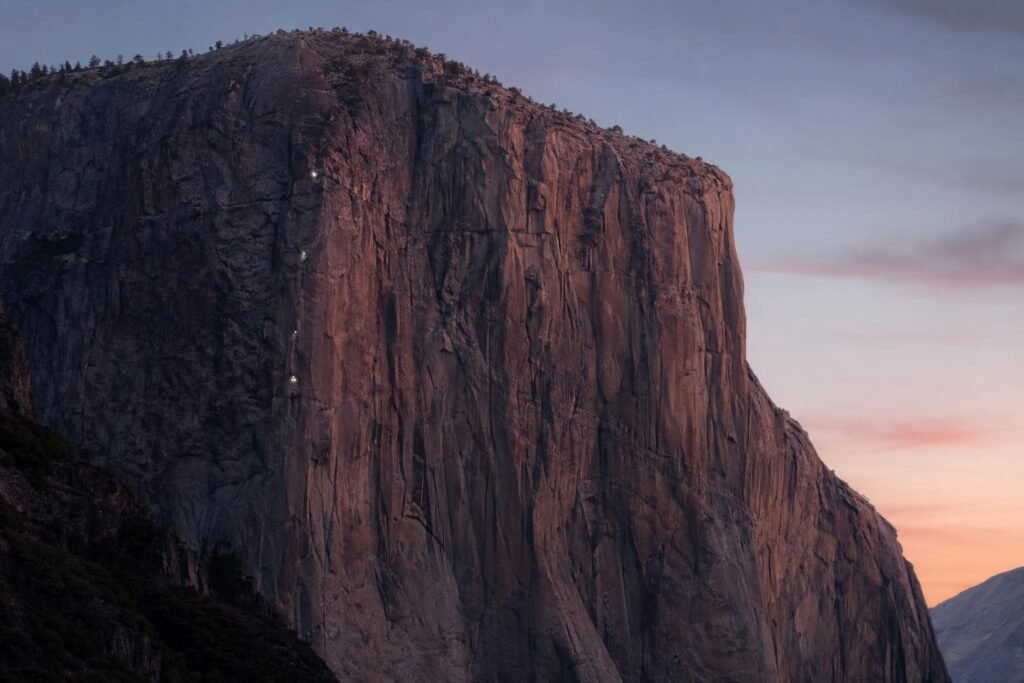
Climbers’ headlamps visible as tiny dots of light on the southeast face, the granite just beginning to catch pink and gold from the east
Valley View is the opposite bookend—west end of the valley, best at sunset. You get El Cap reflected in the Merced River when the water’s calm. The rock glows orange-pink in late light while the valley floor goes dark. It’s maybe a 100-yard walk from the parking area, which means it’s also packed, but the view’s worth dealing with other humans for 20 minutes.
For Half Dome, forget the valley floor—you need elevation. Glacier Point gives you that eye-level perspective at 3,200 feet above the valley. You’re looking directly at Half Dome’s sheared face from about a mile away. Washburn Point is one pullout before Glacier Point, slightly better angle, way fewer people.
Sentinel Bridge for El Cap’s reflection, though you have to time it right. Spring when the water’s high and early morning when it’s still. The bridge itself is narrow and you’ll be sharing space with tripods and other photographers trying to get the same shot Adams got in 1968.
If you actually want to understand what you’re looking at—the geology, the climbing routes, why these formations matter—I ended up doing a guided valley orientation tour my third visit after realizing I’d been staring at rocks for years without really seeing them. The guide pointed out features I’d walked past a dozen times. You get five hours after to hit trails on your own with actual context about what you’re photographing.
Cook’s Meadow Loop gives you ground-level perspectives of Half Dome with wildflowers in the foreground if you time it right—late May, early June usually. It’s flat, easy, and most people skip it for the big trails, which means better shooting conditions.
Swinging Bridge area for reflections of Yosemite Falls and the surrounding walls. Less crowded than Sentinel Bridge, though the compositions aren’t quite as dramatic.
The thing about photographing these walls: everyone’s already taken the famous shot. The challenge is finding the angle that isn’t in every Yosemite book ever printed. I’ve had better luck shooting in bad weather—storm clouds over El Cap, mist obscuring Half Dome’s summit—than trying to replicate perfect conditions that ten thousand other photographers have already nailed.
The Climbing Culture: Watching and Understanding the Vertical World
You’ll see them if you bring binoculars to El Cap Meadow. Tiny dots inching up 3,000 feet of vertical granite, sometimes not moving for hours.
Yosemite invented modern rock climbing. Not the activity itself, but the ethics, the gear, the whole religion of it. In the 1950s and 60s, guys like Royal Robbins and Warren Harding figured out how to live on these walls for days. They’d haul water, sleep in hammocks called portaledges, and slowly drill their way up routes that seemed impossible.
The Nose on El Capitan is the most famous. It took Harding 47 days spread over 18 months to first climb it in 1958. Now speed climbers do it in under two hours. Alex Honnold free soloed it—no rope—in 2017, which is essentially a controlled form of insanity that most climbers will tell you they’d never attempt.
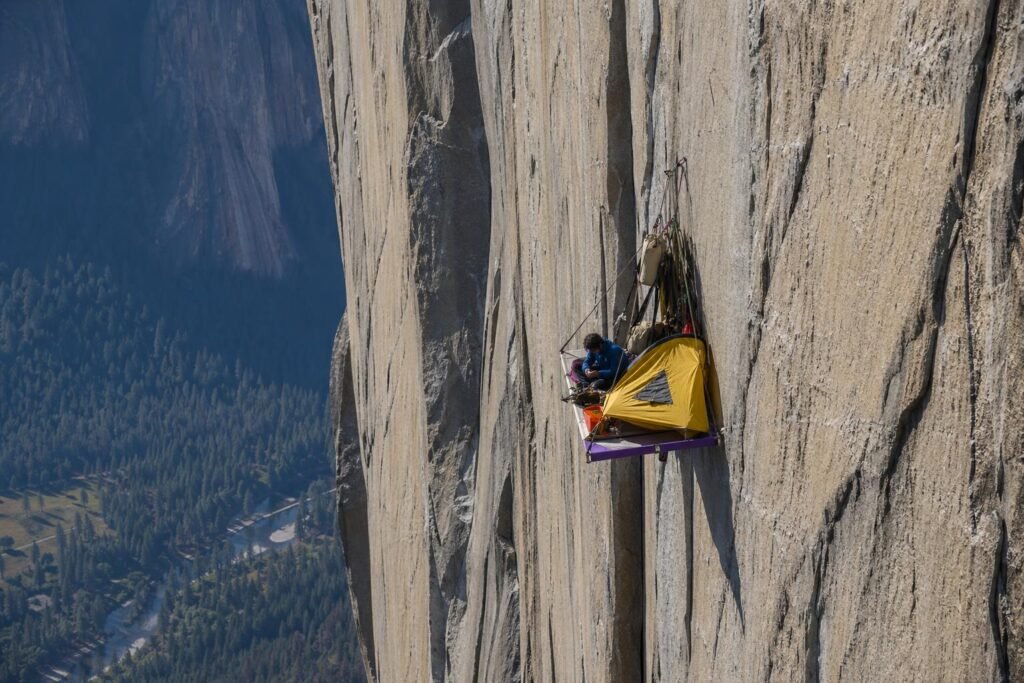
Small colorful portaledge tent hanging from sheer granite face 2,000 feet up, climber visible as tiny figure sorting gear on the suspended platform
Camp 4, the walk-in campground near Yosemite Village, is where the culture lives. Climbers have gathered there since the 1960s—it’s a dirt lot with picnic tables where people argue about beta (route information) and nurse their shredded fingers. Walk through on a May evening and you’ll hear a dozen languages. The ranger talks are good too, especially the ones about climbing history.
If you want to understand what you’re watching, I ended up taking a guided valley orientation tour that spent an hour just explaining the geology and the route systems. The guide pointed out Heart Ledge on El Cap where climbers often bivy, and explained why certain cracks are harder than they look. Made the whole scene less abstract.
The thing is, you don’t have to climb to get it. Watching through binoculars from the meadow, you start to see the chess game. That climber hasn’t moved in 20 minutes because they’re placing protection, not because they’re stuck. That dot of color is their haul bag with five days of food and water.
Early morning is best for watching. The walls light up and climbers are moving after their dawn start. Bring a spotting scope if you’re serious—rangers sometimes set one up at the meadow and let people look.
Hidden Gems: Lesser-Known Rock Formations Worth Exploring
Cathedral Rocks anchor the south side of the valley, but most people drive right past on their way to El Cap.
Three granite spires, each one worthy of being a national park centerpiece anywhere else. The tallest, Higher Cathedral Rock, stands at 2,000 feet. The Spires are sharper, more Gothic than El Cap’s blank face. In late afternoon, they turn this deep amber color that’s almost unreal.
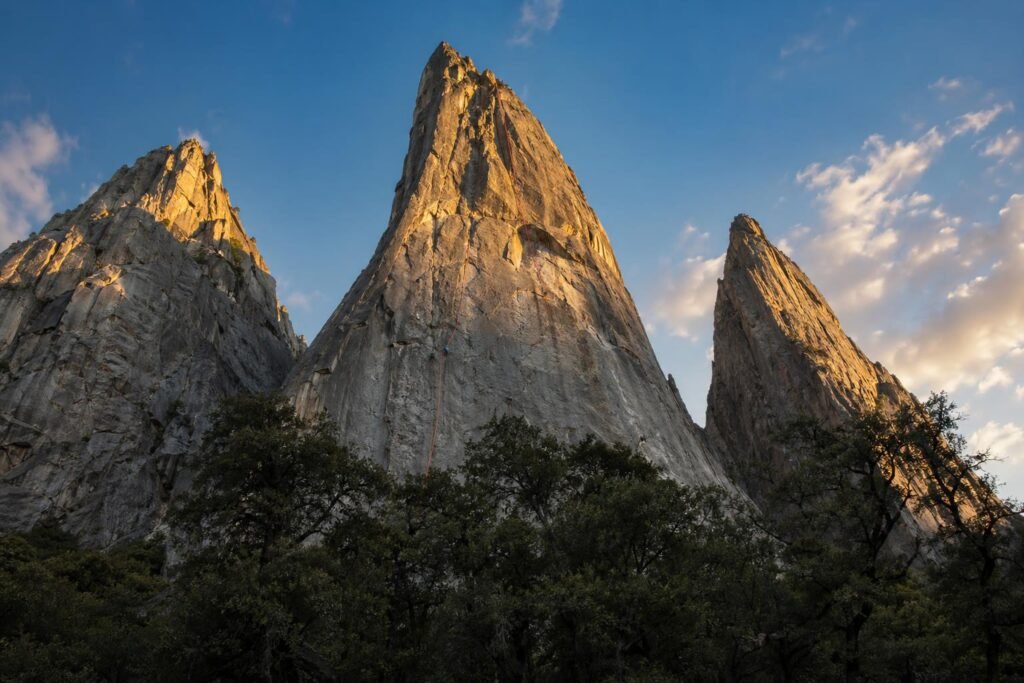
Three jagged granite spires rising against blue sky, foreground oak trees in shadow, dramatic scale showing climbers’ ropes as thin lines on the middle spire
The best view is from the Valley View pullout heading west. Or hike up to the Cathedral Lakes trail—the lower lake has a view back down that shows you how these formations connect to the high country backcountry. It’s a different perspective than the valley floor offers.
Sentinel Rock is the other overlooked giant. It’s 3,000 feet tall, basically El Cap’s height, but it sits back from the road so it doesn’t photograph as dramatically. Climbers love it though—the routes are classic and there’s almost never a crowd.
You can see it well from the Four Mile Trail, especially in the first mile of switchbacks. Middle Brother and the Three Brothers formation are east of El Cap, progressively smaller summits that look like someone stacked them. They’re beautiful in their own right, less severe than the big walls.
Liberty Cap and Mount Broderick frame the back of the valley near Vernal Fall. Smooth domes that caught the same glacial polish as Half Dome. Most people miss them entirely because they’re focused on the waterfalls, but if you do the Mist Trail to the top of Nevada Fall, you’ll walk right past them.
The thing about these lesser formations is the solitude. I sat at the base of Sentinel Rock for an hour one June morning and saw three people. The granite’s the same quality, the climbing history nearly as rich. Cathedral Rocks has routes from the 1940s that are still considered test pieces.
Middle Cathedral Rock has a formation called the Rostrum—a 800-foot prow of perfect granite that juts out like a ship’s bow. It’s one of the most photographed climbs that non-climbers have never heard of.
Seasonal Considerations: When to Visit for the Best Rock Face Experience
Late spring hits different here. May through early June, you get waterfalls at full roar—Bridalveil and Yosemite Falls blasting down the granite—which makes the rock faces even more dramatic. The contrast between white water and gray stone is unreal in photos.
But here’s the trade-off: crowds. Memorial Day weekend? Parking at valley view pullouts before 8am or forget it.
I’ve been in July when it’s 95 degrees and the falls are trickling. The rock faces still dominate, obviously, but you lose that dynamic element. What you gain: empty trails at sunrise. Half Dome looks almost purple at 6am in summer heat.
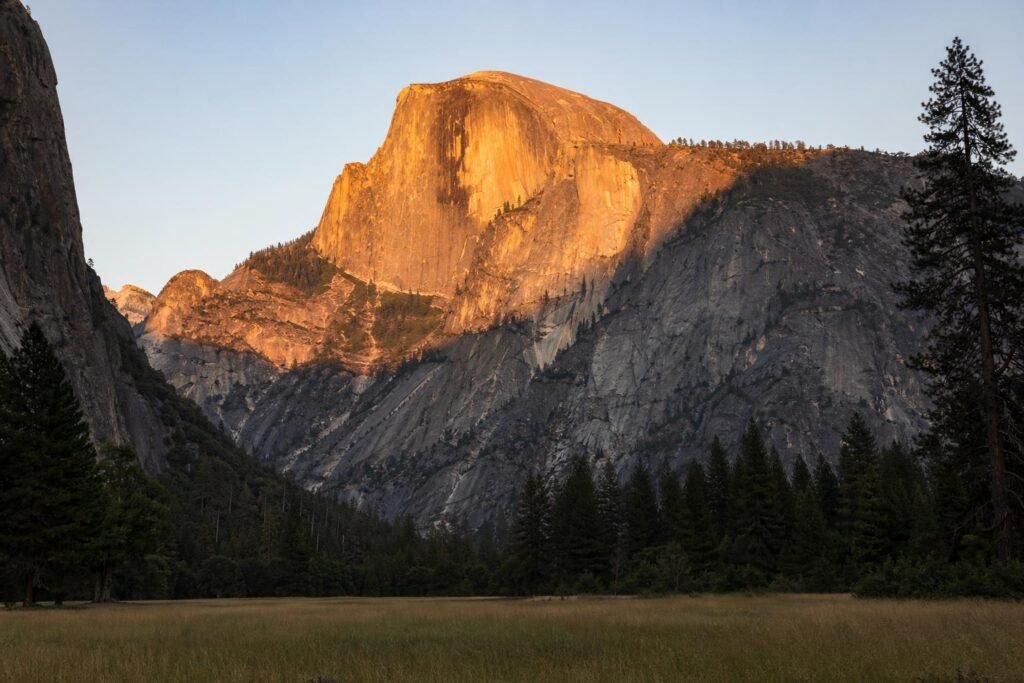
Half Dome rising 5,000 feet with dried Yosemite Falls barely visible as a dark streak down the granite, golden hour casting orange on the rock face while valley floor remains in shadow
Fall—September through October—is what locals recommend. Waterfalls are done, but the air is crisp and visibility goes for miles. El Cap looks sharper somehow. And you can actually find parking at Tunnel View.
Winter transforms everything. I’ve seen El Cap with snow plastered on the ledges, Half Dome’s cables removed until spring. The Ahwahnee Meadow turns into the best viewing spot because Tioga Road closes. You get the rock faces with a whole different personality—quieter, more severe. Just bring chains for your tires and check NPS alerts. Rockfall increases when ice thaws.
Spring storms in March and April mean closures but also fresh snow on the domes. Worth the gamble if you’re flexible.
Practical Tips: What to Bring and Safety Considerations
Binoculars changed my Yosemite experience completely. Not kidding. I borrowed a pair from another visitor at El Cap Meadow and suddenly I could see individual climbers on The Nose, their portaledges, the actual cracks they were following. Get 8×42 or 10×42 magnification—anything higher and you can’t hold them steady enough.
A real camera beats your phone for the rock faces. Even a basic mirrorless with a zoom lens. Your iPhone makes El Cap look like a bump.
Layers. Always. I’ve stood at Glacier Point in June wearing a down jacket at sunset while it was 80 degrees in the valley two hours earlier. The exposed viewpoints get wind that comes off those granite walls cold, even in summer.
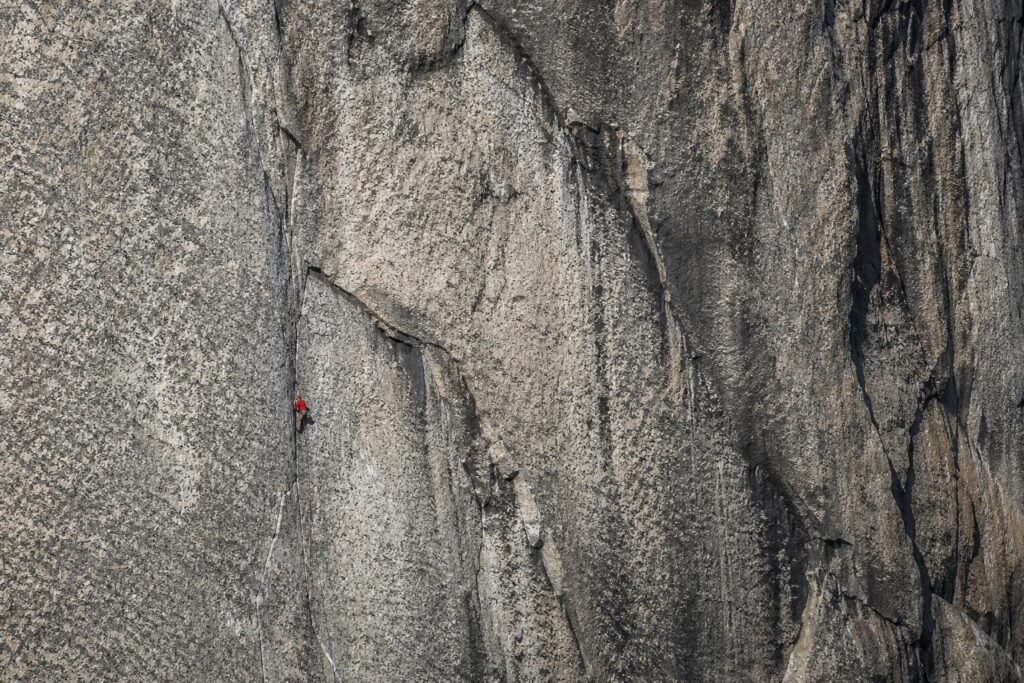
Textured granite surface showing crystalline structure and natural crack systems, with a tiny red figure of a climber visible against the gray stone for scale
For safety: stay behind railings at developed viewpoints, obviously. But also—and people ignore this—watch where you walk at informal pullouts. The granite gets polished smooth from foot traffic and it’s slick when wet or dusty. I saw someone slip at Valley View and they slid six feet before stopping.
If you’re hiking to rock face viewpoints like Columbia Rock or the Mist Trail, start early. Not for crowds—for heat. Those granite pathways turn into radiators by noon. Bring three liters of water per person minimum.
Check the NPS rockfall alerts before heading out. Yosemite loses about 80 rockfalls per year. Most are small, but in 2017 a slab came off El Cap and killed someone on the ground. The meadow viewing areas exist partially because they’re outside the fall zones.
One thing nobody mentions: neck strain. You’re looking up constantly. I’m serious—take breaks, stretch. After a full day staring at Half Dome I could barely turn my head.